Basic HTML Version




Your health
WHAT BEGAN AS a typical weekend day for
Michael Canaday and his grandson, John,
nearly turned tragic.
Instead, they’re both fully recovered after
becoming the first emergency room patients
to be treated for carbon monoxide exposure at
the Hyperbaric Center at Sacred Heart Medical
Center (SHMC).
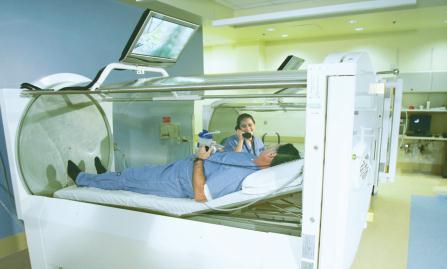
The chamber room at Sacred Heart Medical
Center’s Hyperbaric Center.
Oxygen
therapy
Help for a host of
health problems
Michael, a 59-year-old Eugene man, was
working in his auto shop with John, 14.
Because it was a cold day, Michael had the
shop doors closed and was using a propane
heater. As they worked on a vehicle, Michael
turned on the engine and let it run. He and
John had no idea that colorless, odorless and
deadly carbon monoxide gas was building up in
the shop.
John was first to complain of a headache
and nausea, although Michael was having the
same symptoms.
“I thought it was just me, and without John
bringing it to my attention, I may not have had
the presence of mind to seek fresh air and ask
for help,” Michael says.
An emergency call
John soon lost consciousness, and Michael
stumbled inside and told his wife to call
911. Paramedics arrived and took both John
and Michael to SHMC. Emergency room
physicians confirmed the diagnosis of carbon
monoxide exposure.
Robert Barnes, MD, medical director of
SHMC’s Hyperbaric Center, talked to John
and Michael about hyperbaric oxygen therapy
(HBOT).
“Hyperbaric oxygen therapy is an effective
treatment for acute carbon monoxide
poisoning,” says Dr. Barnes. “Patients
in our hyperbaric chambers
breathe 100 percent oxygen at
pressures two to three times the
normal atmospheric pressure,
which pushes oxygen into the
bloodstream. This prevents the
brain injury that can occur following
carbon monoxide poisoning.”
John was the first pediatric
patient to undergo treatment
at Sacred Heart, and he and his
grandfather became the first
emergency room patients to be
treated at the Hyperbaric Center
for carbon monoxide exposure.
HBOT benefits
In addition to treating carbon monoxide
poisoning, hyperbaric oxygen therapy can be
helpful for people with:
■■
Certain types of wounds, injuries and
infections.
■■
Skin grafts that aren’t healing.
■■
Bones damaged by radiation therapy.
■■
Decompression sickness, or the bends.
Michael and John feel great and haven’t had
any additional side effects or complications.
Michael hopes that sharing his story with
others will increase awareness among those
who may come into contact with deadly carbon
monoxide gas.
For more information, visit the
Hyperbaric Center’s website at
www.peacehealth.org/hyperbarics
.
Scan this code with your mobile device
to watch Kay Wilson describe how
hyperbaric oxygen therapy changed
her life after cancer treatment.
12
Health Connection